

September 4, 2026
Josh Easby
Only a fraction of the roughly 25,000 mining companies worldwide follow any responsible-mining standard at all, and the ones that do have had to choose from four different ones.
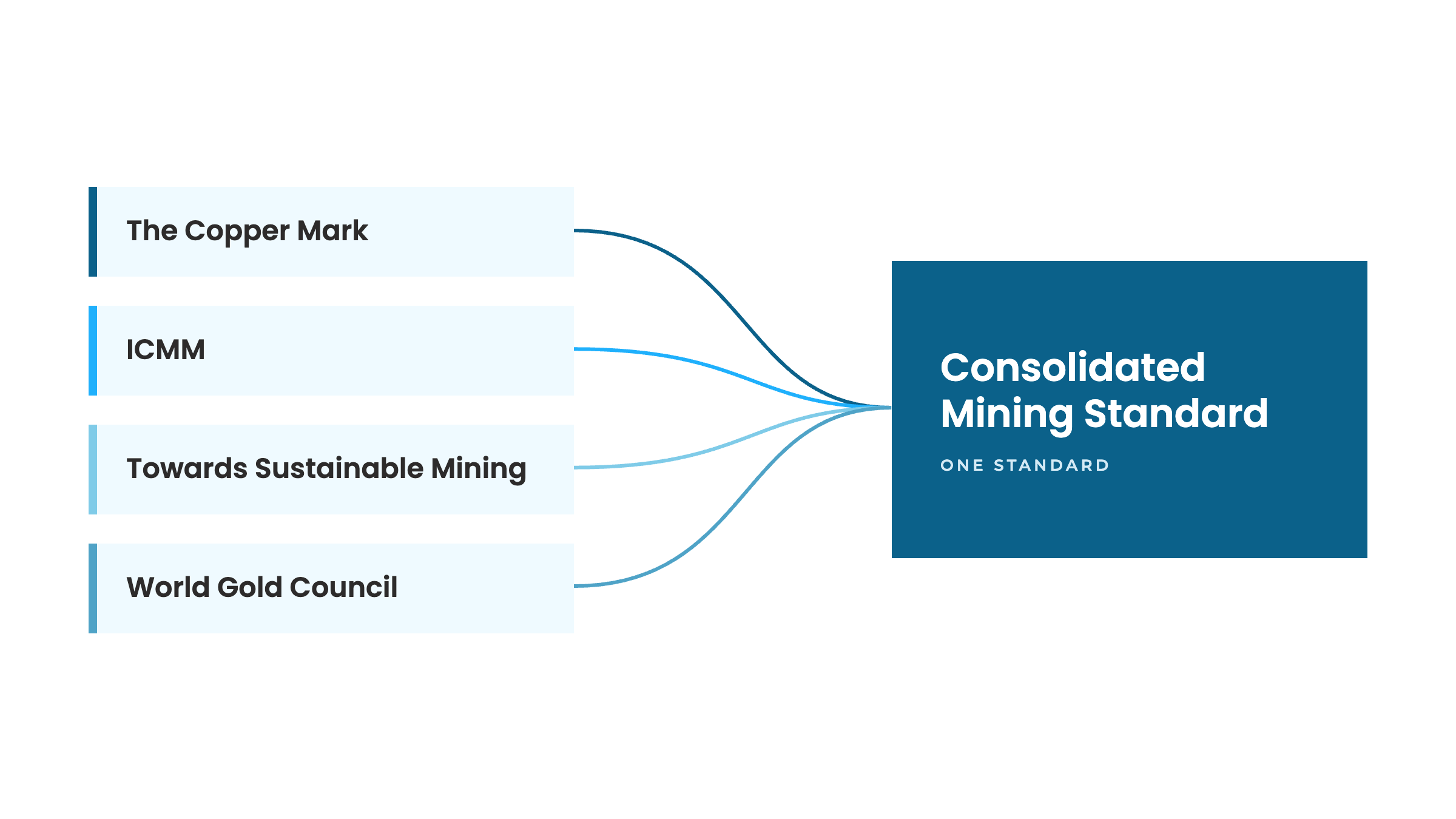
Before the Consolidated Mining Standard Initiative (CMSI) came along, those four standards existed side by side: The Copper Mark, ICMM's Mining Principles, Canada's Towards Sustainable Mining (TSM), and the World Gold Council's Responsible Gold Mining Principles, each covering different areas of what responsible mining means. CMSI was created to fix exactly that, bringing all four together into one internationally recognized standard.
CMSI was first announced on November 28, 2023, when its four founding organizations, The Copper Mark, ICMM, the Mining Association of Canada, and the World Gold Council, said they'd combine their separate standards into one. Since then, they've been drafting the new standard and gathering feedback from the public and industry partners. The first public consultation ran in late 2024, and the final consultation draft went through its last public comment period in October and November 2025.
The standard is now in its final stretch. The remaining board appointments are expected by the end of this quarter, and CMSI expects to finalize the standard itself later this year, at which point companies will begin the transition.
The consolidated standard covers 24 Performance Areas across four pillars: Ethical Business Practices, Worker & Social Safeguards, Social Performance, and Environmental Stewardship. Performance is scored across three levels:
Why would a mine sign up for something like this at all, given it's voluntary? Several reasons usually come together. It's a credible way to show you're managing environmental, social, and health & safety risk in a way people outside the company actually believe. That credibility builds investor and community trust, opens doors to markets, and tends to smooth out permitting, since stakeholders and rightsholders feel more confident the company is in it for the right reasons.
Once CMSI finalizes the standard, mine sites will prepare annual self-assessments and undergo independent external assurance every three years, an evaluation that goes beyond reviewing documents to include direct interviews with workers, stakeholders, and rightsholders.
Across its 24 Performance Areas, CMSI cares as much about how the work gets done as what gets written down. Engagement, is a good example. It means reaching stakeholders and rightsholders in ways that are accessible and culturally appropriate, holding separate conversations with women and vulnerable or underrepresented groups where needed, and showing how their input actually shaped decisions, beyond simply holding a meeting.
It's not enough to say the process happened. CMSI wants to see it happen in the field, in enough detail that an outsider could check the record and reach the same conclusion. Producing that kind of evidence is what naturally prompts a company to think carefully about how it runs engagement day to day, and how it collects the record of it, since a defensible record protects the company too, not just the assessor reviewing it. A company can hold the meetings, run the engagement, and make the commitments, and still struggle the moment someone asks for the record of what was said, who owns what, whether it happened. Without a real system connecting that work, companies end up chasing down old emails and half-updated spreadsheets, managing the evidence instead of managing the performance.
If you’re using Excel, SharePoint, and email to track this today, you’re not alone, and there’s nothing wrong with that. At a certain scale, it works fine. Where it gets difficult is as things scale. More stakeholders to track, more engagement activity happening at once, a growing team, more commitments piling up, and more regulatory oversight watching how well it's all managed. Someone still has to manually add every record, which leaves room for human error, and it's easy to put off when there's other work competing for time. Over time, that gap in the data grows without anyone noticing.
A system built for this makes the logging itself easier and standardizes how it happens, so the data stays clean, the reporting built on top of it stays clean too, and a company can stay ahead of social risk instead of reconstructing the story from a handful of different inboxes. It's most useful when it doesn't stop at engagement and covers more of the standard's Social Performance areas at once. At NetBenefit, that's what we aim to help with, bringing more of these Performance Areas into one system that's easy-to-use day to day. For example, here’s how some of our modules support the different performance areas.
Engagement & Relations tracks who you engaged, what you heard, and what you did next, the same ground covered under Performance Area 12, Engagement.
Under Performance Area 14, Indigenous Peoples, CMSI asks facilities to report on progress delivering the commitments made in their agreements. Agreements & Commitments is built for exactly that, creating a traceable path from commitment to owner to action to completion to evidence.
Local employment, procurement, and community development progress all need to be tracked and publicly disclosed under Performance Area 13, Community Impacts and Benefits. Benefits Tracking connects a community priority to a commitment, to the activity behind it, to the actual benefit or outcome delivered.
The same kind of connection applies to grievances. CMSI expects a real way for communities to raise concern and have it resolved, not just logged, under Performance Area 17, Grievance Management. NetBenefit's grievance management closes that same loop, from a concern raised to how it was resolved.
Together, these threads connect into one evidence trail that management or an assessor can follow without rebuilding the story from multiple systems. A real system lets a company manage, document, monitor, and demonstrate the work behind its performance, all while using that same data to make better decisions and improve over time.
A few questions worth sitting with, about where things potentially stand today with your current systems:
CMSI is still finalizing. But whichever level you’re aiming for once it does, the answers to these questions are worth knowing now.

.png)
.png)
.png)